
DRS 28377 - Part 2 - Examining the Conduct of the Experts
DRS 28377 Part 2 - Examining the Conduct of the Experts
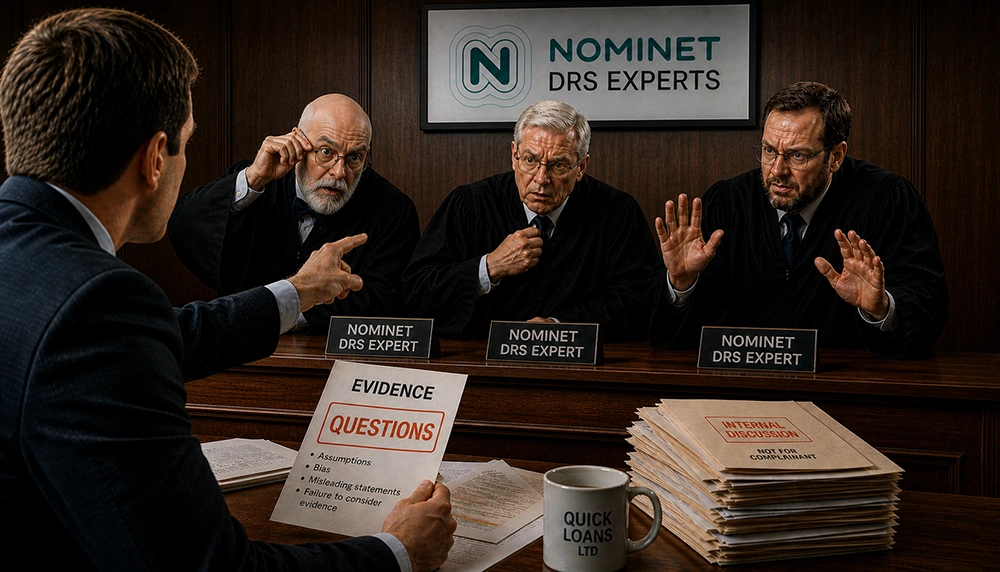
This blog post is not intended to challenge the finding that the domain name should be cancelled. It is clear, under the applicable rules, that this matter should not have been accepted as a DRS case.
My focus is instead on the conduct of the Experts, and in particular the publicly stated narrative in which my conduct is criticised.
I apologise in advance for the length of this article. However, given the nature of the findings made and the level of detail omitted from the published narrative, anything less than a careful and forensic examination would not do the issues proper justice.
Timeline
Before turning to the substantive issues, I note that the Appeal Panel did not repeat the first Expert’s characterisations of my case as “misleading” or that I “must have known” certain facts.
In my appeal submissions, I expressly challenged the Panel not to repeat such allegations - whether arising in this case or in any previous DRS I have been involved in - unless they were prepared to identify the specific matters relied upon and afford me a proper opportunity to respond. That was a clear and deliberate invitation, not a passing remark.
The Panel chose neither to repeat those allegations nor to engage with that invitation. I think this speaks volumes.
Reverse Domain Name Hijacking label
The Appeal Experts appear to have identified four issues with my DRS Complaint. Those issues seem to have formed the basis for attaching the label of Reverse Domain Name Hijacking. I do not know what weight the Experts gave to each point, or whether they regarded some as more serious than others.
The issues appear to be:
- 1) My use of the word “successful” in relation to a trade mark application that remains ongoing.
- 2) Their view that I should have known the identity of the Respondent before the dispute fee was paid, and that the Complaint should therefore have been withdrawn, amended, or resubmitted.
- 3) Their conclusion that the Respondent was the original registrant in 2014, meaning the registration could not have been abusive.
- 4) Their finding that, because the Respondent no longer exists, the domain name should have been cancelled and the DRS Complaint could not succeed.
- 5) Lack of evidence submitted by Complainant.
I will address each of these points in turn, explain the reasoning behind them, and set out why I do not accept that the Experts approached these issues fairly or in good faith.
1) Use Of The Word "Successful"
The Appeal Experts state:
1.1 - That Looks Deceptive
Anyone reading the Panel’s summary would reasonably assume that I had described my trade mark application as “successful” in the sense that I had secured registered rights. If that were all I had said, that interpretation would be fair.
But that is not what I said, and it is not how the statement was presented.
1.2 - Selective Quoting
Why has the Panel chosen to quote my wording in a way that changes its meaning?
By isolating the word “successful”, the passage creates the impression that I was asserting that a trade mark had been obtained. That is not what I said.
Immediately after using that word, I made clear that the application had been opposed by a third party. That is critical context. It makes it obvious that the application had not been granted and that its status was ongoing.
When the statement is read in full, it is not capable of bearing the interpretation suggested by the Panel. The omission of that context materially alters its meaning.
This was not a single-expert observation. It appears in a decision signed by all three members of the Appeal Panel. That makes the absence of the qualifying context all the more difficult to understand.
It is also notable that the original Expert did not identify this wording as misleading, and appears to have understood the statement in the way it was intended.
The issue, therefore, is not the use of the word “successful” in isolation, but the way in which the surrounding explanation has been excluded from the Panel’s narrative.
1.3 - "Panel Doesn't Understand" - Really?
I take issue with the Panel’s statement that it did not “understand” the basis on which the trade mark application was described as “successful”.
In my appeal submissions, I expressly invited the Panel to raise any questions or concerns - whether in relation to this point or any other aspect of this or previous DRS proceedings - and to afford me the opportunity to respond. That invitation was clear and open. If the Panel’s objective had been to clarify or properly understand the position, there was a straightforward route available to do so.
No such step was taken.
In those circumstances, it is difficult to reconcile the stated lack of understanding with the decision to proceed to adverse conclusions on that basis. The impression created is not one of a genuine attempt to resolve uncertainty, but of a willingness to adopt a narrow interpretation of the wording in order to support a finding that the Complaint was misleading.
1.4 - Justifying Our Statement
The Appeal Experts say that " the panel does not understand how the Complainant can justify characterising this trade mark application as “successful” in its Complaint".
Had the panel asked, we would have explained it to them:
- "Successful"
"In late 2024 - The Complainant’s representative successfully applied for the trade mark “QuickQuid” in Class 36 (financial services), and the application was accepted by the UKIPO"
When the application was submitted, the IPO examiner was initially reluctant to proceed due to existing trade marks in Class 36 owned by CashEuroNet UK, LLC. There was also a separate trade mark in Class 35 which we had opposed, and that opposition remained ongoing at the time.
In response, we set out our position in detail, including our existing unregistered rights, our use of the domain name, our FCA registration, and approximately 15 months of trading in Class 36 financial services without objection. Following that explanation, the examiner accepted the application and allowed it to proceed.
These were not routine steps. The application progressed only after substantive engagement with the examiner and the provision of supporting reasoning. - The Objection:
"It progressed without issue until an objection was filed by an unrelated third party."
Here we clearly explain that someone objected, we know who that party is and we know that they are not whoever the Respondent turns out to be in this dispute. - Underlying Rights:
"and their objection does not affect the Complainant’s underlying rights.”
This statement refers to the underlying rights presented to the examiner, including the domain name, FCA registration, and our established trading history within FCA-regulated activities (including application volumes and customer interaction).
While the objection may ultimately affect whether the trade mark is granted, it does not undermine the substance of the material placed before the examiner, which was sufficient for the application to progress to the next stage - and therefore should also be enough to clear Limb 1 of the Rights a DRS needs to progress to Limb 2.
1.5 - Earlier Applied For Mark
The Panel refers to the existence of an earlier trade mark, which is correct. However, it does not make clear that this mark is registered in a different class from the one in which we applied, nor that we do not offer any goods or services in that class. Specifically, we have no current or planned activity in Class 35.
For completeness, I note that in those IPO proceedings, it has been asserted that I had prior knowledge of that application and gave permission. That assertion is not supported by the evidence. There is a recorded call, which the individual (a Solicitor) in question has access to, that directly contradicts those assertions. Despite this, the claim has continued to be advanced before the IPO. It's one of the reasons I have difficulty finding that those in the legal profession should automatically have the default position of trust.
That said, I consider the Panel’s omission on the class distinction itself to be relatively minor, and I refer to it here only for completeness.
1.6 - Summing Up - The "Successful" Attack Line
It is difficult to see how that statement, when read in full, could reasonably be characterised as misleading. If the Experts considered any part of it unclear or open to interpretation, there was a straightforward and fair course available - to seek clarification.
What is more difficult to understand is why three experienced professionals would rely on a partial quotation while omitting the surrounding context that gives the statement its proper meaning.
2) The ‘Should Have Known’ Argument
The Appeal Experts state:
2.1 - Here is what I knew at the time
To address the Panel’s point directly, I do not have a precise recollection of when I became aware that the Respondent was CashEuroNet UK, LLC. However, I do not believe this was before I paid the fee for the summary decision.
In any event, for reasons I will address in more detail later, I did not consider the identity of the Respondent to be determinative. The Complaint had already been framed broadly to cover the possible scenarios arising from an unknown or uncertain registrant. At the time of filing, there was no clear basis to conclude that any particular party held the .uk domain.
Even if the Respondent were CashEuroNet UK, LLC, my understanding at the time was that, following dissolution, the domain would fall to Bona Vacantia, and that the relevant authority would then stand in its place for the purposes of the dispute. I was aware of DRS01409 (tigerbeer.co.uk), which deals directly with .uk domain names in the context of Bona Vacantia. I was unable to identify any more recent authority contradicting that position, there is no guidance for this in the Domain "Expert Overview" and the reasoning in that decision appeared sound.
On that basis, even if I had known with certainty that the Respondent was CashEuroNet UK, LLC, it would not have altered my approach to the Complaint. I will address this point in further detail later.
2.2 - Experts Say I Was Aware of Underlying Respondent
The Experts state, on more than one occasion, that I was aware of the Respondent’s identity. They rely on correspondence dated 2 December 2025 and 24 December 2025, both said to have been received before the summary decision fee was paid.
That account is incomplete and misleading.
The Experts had access to correspondence between GoDaddy and Nominet from late November which highlights the difficulty in identifying and updating the registrant details at the relevant time. The Experts omit this from their narrative. The domain was behind GoDaddy’s privacy service when the Complaint was submitted, had entered suspension, and there were acknowledged issues in updating the underlying registrant information. This resulted in delay and, importantly, a lack of clarity. I was not included in any emails stating that this had been resolved.
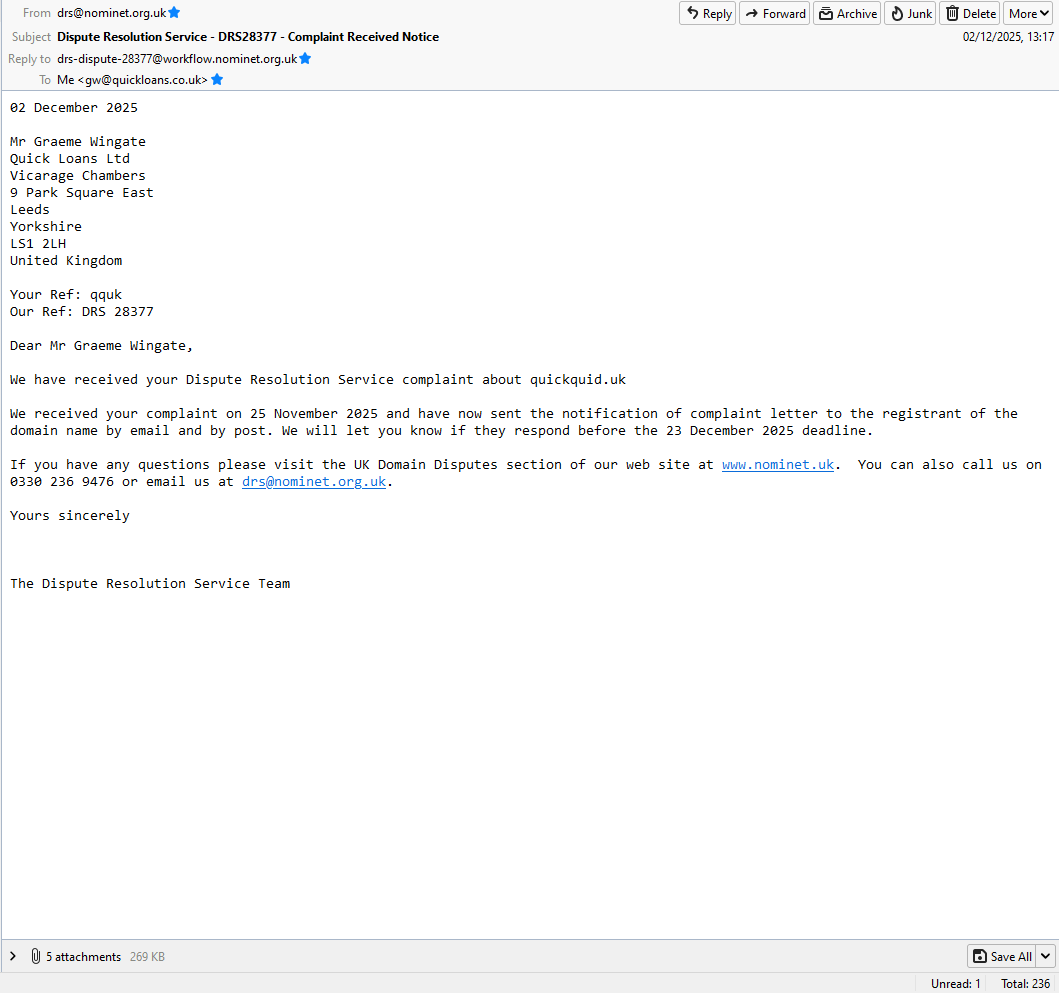
2.3 - 2nd December Email
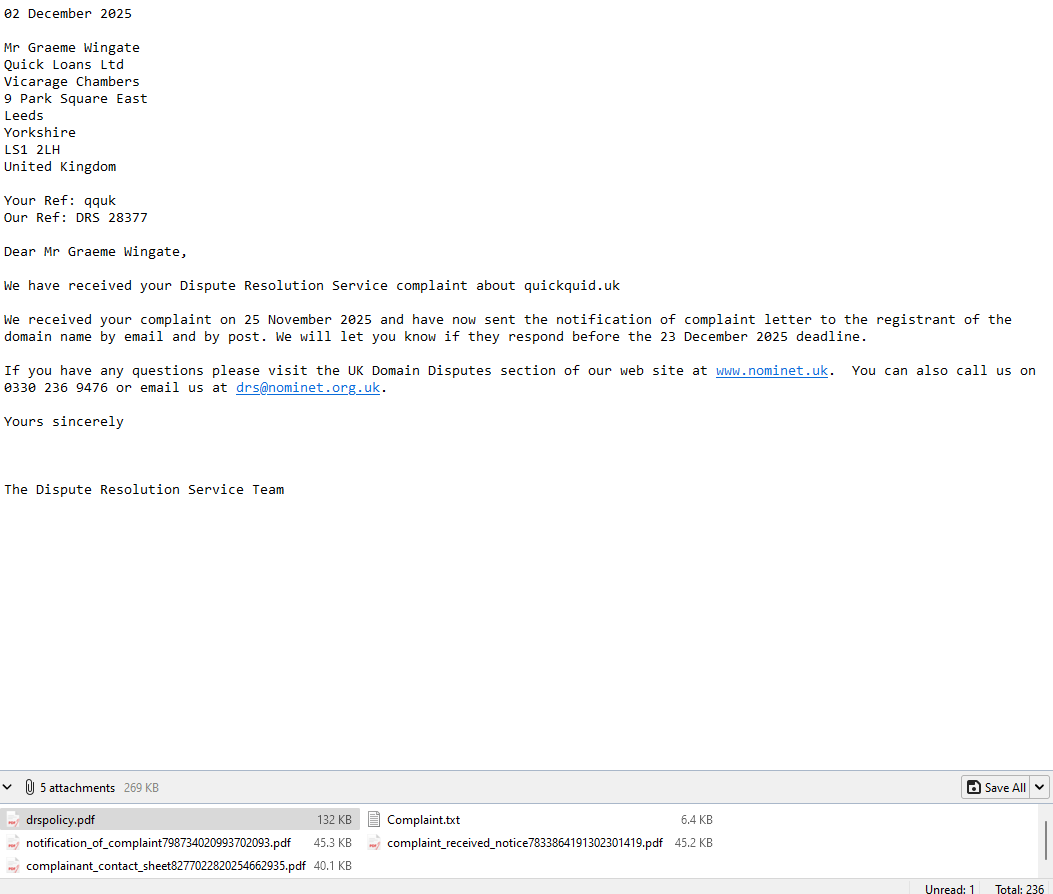
The Panel’s position appears to be that I should have identified the Respondent as CashEuroNet UK, LLC from the 2 December email. However, that information does not appear in the body of the email itself. At best, it is contained somewhere within one of several attachments.
The practical question is therefore straightforward: where, in the email as received, was the Respondent clearly identified?
And, when faced with multiple attachments, which of them clearly indicated that it contained the Respondent’s details?
2.4 - 24th December Email
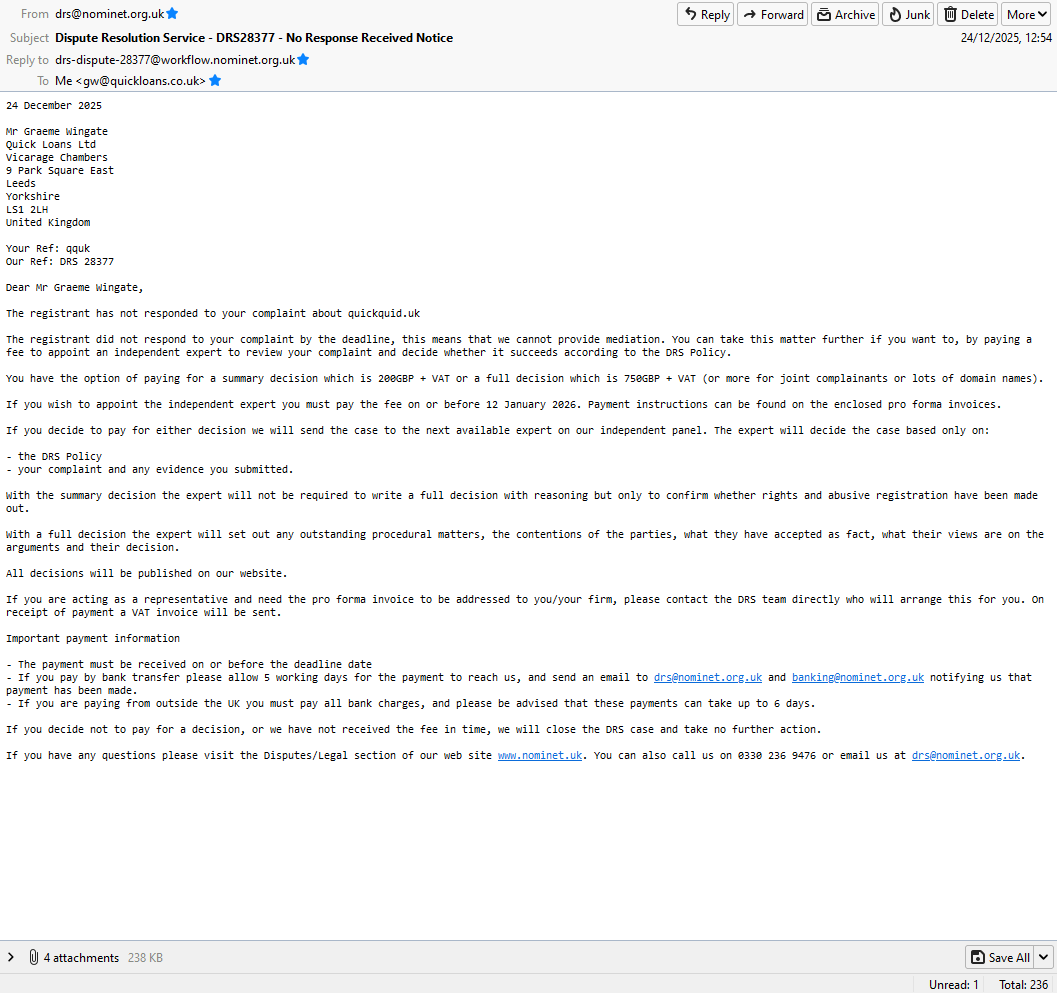
The same issue arises in respect of the 24 December email. The Panel again asserts that I was informed of the Respondent’s identity by that point. However, the email itself does not state this in the body, nor do the attachments clearly signal that they contain the Respondent’s details.
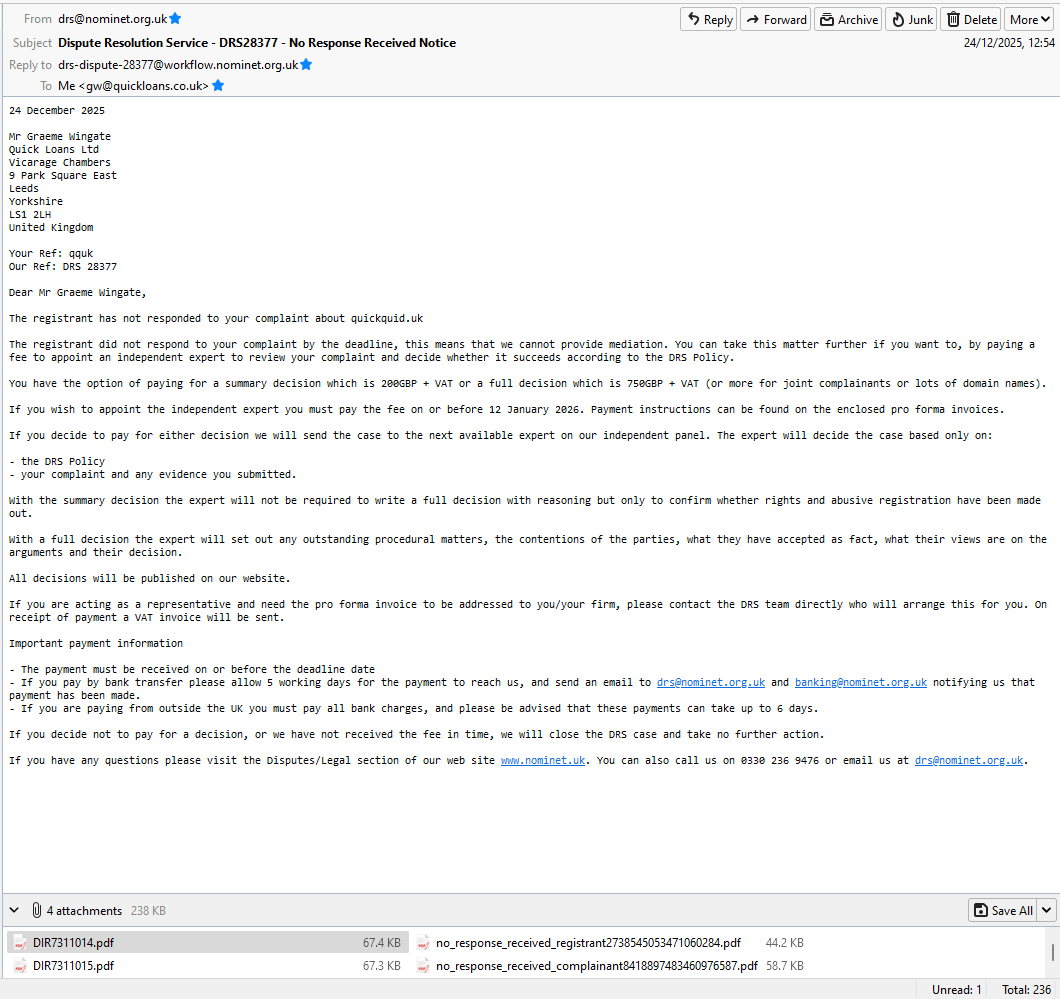
2.5 Complainant Should Have Resubmitted/Amended Complaint.
The suggestion that I should have withdrawn, amended, or re-submitted the Complaint raises a much broader issue that the Experts should reflect on carefully.
Withdrawal is one thing. But the idea that a complainant should adapt or reconstruct their case mid-process, depending on information that only becomes available after filing, is something else entirely. Taken to its logical conclusion, that approach risks encouraging what is often referred to as complaint tasting - filing a case to see what emerges, and then reshaping it accordingly.
That is not how the DRS is intended to operate. The process is designed to be front-loaded, with parties expected to set out their case fully and properly at the outset. It is not an iterative system where arguments are refined in response to developments as the case unfolds.
That principle is made clear in the Experts’ own Overview:Overview document says:
“If parties get the idea that they can simply improve their cases as the proceeding progresses, there will be no incentive upon them to adhere to the Policy and put their best case forward first time around.”
Against that background, it is difficult to reconcile the criticism made of the Complainant here. On the one hand, the guidance underpinning the DRS discourages parties from evolving their case as the process progresses. On the other, the Complainant is criticised for not doing exactly that.
That tension goes to the heart of the reasoning.
2.6 - Summing Up - The "Should Have Known" Attack Line
I have nothing to hide and no reason to misrepresent my position. I state this plainly - even if I had known at the time that the Respondent was Casheuronet UK, LLC, I believe I would still have proceeded with the DRS. I address that in more detail in Section 4.
What I firmly reject is any suggestion that I knowingly pursued a complaint that I believed should not have been brought, or that I sought to disguise my knowledge of the Respondent’s identity. Equally, I reject the assertion that I “should” have been aware of who the Respondent was. That information was not clearly presented. It was buried within an attachment, with no clear signposting that it contained the Respondent’s details.
The Appeal Panel’s conclusion on this point is therefore difficult to reconcile with the practical reality of how DRS communications are structured. Either there has been a misunderstanding as to how and where that information is conveyed within those emails, or insufficient weight has been given to that context.
In either case, it does not support a finding that I ought to have known the Respondent’s identity at the relevant time, nor does it justify elevating that point into a finding of Reverse Domain Name Hijacking.
3) The "Registered in 2014 so can't be abusive" Claim!
The Appeal Experts state:
3.1 - I Highlighted This In My Appeal
The first Expert in the summary decision made the same point - that the original registration in 2014 could not have been abusive. That Expert has a well-known background in UDRP disputes, and in that context there is at least some explanation for approaching the issue through the lens of the registration date alone. However, the DRS is not limited in that way and expressly allows for consideration of matters arising after registration.
This was not an issue I remained silent on. In my appeal, I specifically identified that this approach reflected UDRP-style reasoning rather than established DRS principles, and I made that point clearly.
3.2 - The 2014 Date Being Key
On this issue, I have serious concerns about the approach taken by the Appeal Panel, particularly given the involvement of Nick G in his capacity as Chair of the Panel of Experts.
The Panel is well aware that the DRS is distinct from the UDRP. One of the key differences is that, under the DRS, abusive registration is not confined to the point of original registration. It can arise at any point where the circumstances justify it. That is a fundamental feature of the Policy.
Against that background, the narrative presented - that the 2014 registration date is effectively determinative - is difficult to reconcile with the established framework of the DRS. It applies a rigid, registration-date analysis that more closely resembles UDRP reasoning than the broader approach envisaged by the DRS.
This was not an issue I left unaddressed. In my appeal, I expressly identified that this line of reasoning reflected UDRP principles rather than established DRS standards. I also explored scenarios in which the registration history may not have been as straightforward as assumed.
It is important to be clear about the purpose of that argument. It was not advanced as a basis on which the Appeal Panel should order a transfer of the domain name. Rather, it was raised to address and correct the public remarks made by the first Expert in the summary decision. Those remarks were framed in absolute terms, relying on an assumed and simplified chronology to suggest that the Complaint could never have had any proper basis. My appeal challenged that characterisation, not by asserting that transfer must follow, but by demonstrating that the underlying assumptions were not as clear-cut as presented and should not have been expressed in such definitive terms.
The context is important. Shortly before CashEuroNetUK LLC entered administration, according to RDAP, the .uk domain appears to have been transferred. That raises an obvious question as to who held the domain at the relevant time and on what basis. That issue was specifically raised, yet it is not addressed in the Appeal Panel’s narrative.
3.3 - The Difficulty Understanding the Shift in Nick G’s Approach
I’ll never use his surname here. I’ve no interest in turning this into something that becomes searchable against him personally, so I’ll simply refer to him as “Nick G”. I may have just referred to him as Nick, but there was another Nick in the videos I have embed.
I have a serious questions about Nick G’s conduct in this matter. The position adopted in the Appeal Decision appears completely inconsistent with the views he publicly expressed during this mid-2025 DRS webcast.
The full webcast itself sits behind a member login wall. By contrast, Nick G’s public criticism of me - including findings of bad faith and Reverse Domain Name Hijacking - sits openly available without restriction. In those circumstances, I consider it entirely fair and legitimate to reproduce the relevant excerpts from the webcast for the purposes of criticism, review, and scrutiny.
3.4 Flexible Principles
In the webcast accompanying this article, Nick G speaks at length about what he considers one of the defining advantages of the Nominet DRS over the UDRP. He explains that the DRS was deliberately designed to avoid rigid fixation on the original registration date and to allow Experts to address situations where a domain name may originally have been registered legitimately but later becomes abusive through subsequent conduct, changed circumstances, or later use.
He describes the DRS “either/or” formulation as “clearly preferable” to the UDRP model. He criticises what he regards as the unsatisfactory rigidity of the UDRP and specifically praises the flexibility of the DRS in dealing with evolving situations long after original registration. This is not presented as some passing or experimental opinion. It is discussed as a foundational and long-established strength of the DRS itself.
The striking thing is that this has not merely been Mr G’s position in one webcast. It has plainly been part of his thinking for many years. He authored the Experts’ Overview, chaired expert discussions, and publicly advocated for a broader, more flexible interpretation of abusive registration specifically because strict registration-date analysis can produce unjust outcomes.
Yet when it came to my own appeal, that long-standing philosophy appeared to disappear entirely.
By the way, I thought NWS explained the distinction between the DRS and the UDRP far better than I ever could.
3.5 - Got a Strawman to sell you
At no stage did I argue that the original 2014 registration of quickquid.uk by the original QuickQuid business was abusive at the moment it occurred. That was never my case. In fact, my appeal expressly stated the opposite: that under the DRS, abusive registration is not confined solely to the original act of registration and may arise later depending on subsequent circumstances.
That was not some radical proposition invented by me. It was entirely consistent with the public position Mr G himself had advocated for years.
My submissions focused on later events and later circumstances:
- the obscured registrant position caused by privacy services;
- the dissolution of CashEuroNet UK LLC;
- the uncertainty surrounding who actually controlled the domain at the relevant time;
- the possibility of involvement by Bona Vacantia, intermediaries, agents, or third parties;
- the passive holding of the domain;
- and whether continued retention of the domain had later become unfairly detrimental under the broader DRS framework.
Those are precisely the kinds of evolving and post-registration issues Mr G publicly says the DRS was designed to address.
But instead of engaging with those arguments, the Appeal Panel largely reverted to the exact type of rigid registration-date analysis Mr G criticises in the webcast.
The decision repeatedly emphasises that the Respondent registered the domain in 2014, that the Complainant did not exist at the time, and that there was therefore “no conceivable basis” for abusive registration. That reasoning addresses a case I was not actually advancing. It defeats a strawman argument while largely sidestepping the broader DRS principles that I had expressly relied upon.
Even more remarkably, the Panel then used the supposed hopelessness of that strawman position as part of the basis for attaching a finding of Reverse Domain Name Hijacking.
That is the extraordinary part.
3.6 - One Standard in Webcasts, Another in Decisions
A complainant relying on the very flexibility of the DRS publicly championed for years by one of the Appeal Experts himself somehow became evidence of “bad faith”.
A complainant raising later-use arguments under a policy specifically designed to accommodate later-use arguments was accused of pursuing a case that “could not possibly succeed”.
A complainant pointing to uncertainty caused by privacy services and unclear registrant history was criticised despite the webcast openly acknowledging that privacy layers can create precisely those kinds of problems.
The contradiction is impossible to ignore.
Either the DRS genuinely is the broader and more flexible system Mr G publicly describes - capable of addressing changing circumstances, later conduct, obscured registrant identities, and evolving unfairness - or it is not.
If those principles are valid enough to be promoted publicly as one of the defining virtues of the DRS system for decades, it is difficult to understand why they suddenly became illegitimate the moment they were relied upon by me.
That inconsistency requires an explanation.
4) The Dissolved Entity and Bad Faith
Nominet Terms and Conditions Relied On By The Experts:
The Experts then further state:
4.1 - This Is The Crux Of The Matter
I describe this as the crux of the matter because, even if the Experts were correct on all of the points above - which I do not accept - I would still have proceeded with the Complaint for the reasons set out in this section.
4.2 - The Dissolved Entity Problem
The Experts appear to say that I should have appreciated two things:
- that CashEuroNet UK, LLC was dissolved or cancelled; and
- that a DRS complaint against a dissolved company could not proceed.
4.3 - Point 1
The first point is not in dispute. Of course I knew CashEuroNet UK, LLC had been dissolved or cancelled. I was the person who put that evidence before the Appeal Panel.
In my Non-Standard Submission, I provided the Panel with the Delaware cancellation documents, which I had purchased myself. These were not free public-domain documents that the Experts had independently discovered. I also provided correspondence between myself and the Bona Vacantia Department.
The Appeal Decision itself acknowledges this:
“The Complainant has in its Non-Standard Submissions also adduced evidence that the Respondent was ‘cancelled’ according to the State of Delaware records no later than 7 January 2025…”
The decision also records:
“After filing the Appeal Notice, on 17 March 2026 the Complainant lodged non-standard submissions primarily directed at the status of the Respondent.”
That matters.
I was not hiding the dissolution issue. I was raising it. I was evidencing it. I was asking the Panel to deal with it.
4.4 - Point 2
The real issue is the second point - whether I should somehow have known that a complaint involving a dissolved company could not proceed under the DRS.
That is where I have a serious problem with the Panel’s reasoning.
If I genuinely knew that the complaint was bound to fail because the Respondent was dissolved, why would I go out of my way to provide the documents proving that very point?
Why would I purchase Delaware cancellation documents, submit them to the Panel, provide Bona Vacantia correspondence, and then build an entire non-standard submission around the Respondent’s status, if I already knew that doing so destroyed my own case?
That makes no sense.
It should have been obvious that I was not trying to conceal the issue. I was trying to understand it, explain it, and have it determined.
That is why I find the RDNH finding so difficult to accept. The Panel treated my continuation of the Complaint as bad faith, but the evidence shows that I was openly putting the very problem before them.
4.5 - This is what the 3 Experts didn't tell you
In my Non-Standard Submissions I was making these statements:
4.6 - They took Our Arguments, Took Our Money and Slapped Us With Our Own Reasoning
What is particularly difficult to explain is that we expressly raised the possibility that, if the Panel concluded there was no valid respondent and that the complaint could never properly have succeeded, the appropriate outcome may have been nullification of the proceedings and reimbursement of the fees paid.
That was not hidden away or implied indirectly. It was specifically put before the Panel. It's not like we were putting all our weight behind getting the name was the only option.
We argued that Nominet had accepted fees at both the complaint and appeal stages despite already knowing that CashEuroNet UK, LLC was the named respondent, and despite the underlying uncertainty surrounding the registrant’s legal status.
The Panel ultimately adopted the core procedural conclusion that we ourselves had advanced - namely that the complaint was effectively incapable of succeeding because the respondent had been dissolved and the domain was subject to cancellation.
Yet the decision does not engage with the proposed refund/nullification point at all.
Instead, the same issue we raised as a procedural defect in the process was transformed into a finding of bad faith against us personally.
That is one of the central reasons why the fairness of the process is now being questioned.
4.7 - Why Did We Think We Could Win If The Respondent Was Dissolved?
Because there was already a historic DRS decision dealing with this exact type of problem: TigerBeer.co.uk (DRS01409).
In TigerBeer, the Expert considered the position where a dissolved company’s domain name potentially passed into Bona Vacantia. The reasoning was that if the domain ultimately sat with Bona Vacantia purely to be sold on, that itself could amount to an abusive registration because the domain would effectively be held for resale against the rights holder’s interests.
That decision was never expressly overturned by a later DRS authority.
Yes, DRS decisions are not binding precedents, but there has never been a later DRS case publicly stating that TigerBeer was wrong in principle. There is also nothing in the Experts’ Overview explaining that dissolved-company reasoning had fundamentally changed.
So when we encountered a dissolved respondent, it was entirely logical to consider TigerBeer relevant. And the Appeal Panel knew this was our reasoning because we expressly cited TigerBeer and explained the point in our submissions.
Again, the reasoning we actually advanced was largely absent from the published narrative. A reader of the Appeal Decision would have little idea that our position was grounded in an existing DRS authority, namely TigerBeer.co.uk, or that we had expressly explained that reasoning to the Panel.
That omission matters. Without that context, the published decision creates the impression that these arguments were invented without foundation, rather than being based on an earlier DRS approach that had never been expressly displaced by a later authority.
Increasingly, it feels as though the burden of restoring that missing context has been left entirely to us.
4.8 - Why Didn't TigerBeer.co.uk Apply Here?
Well, TigerBeer no longer applies in the same way today. In the period following the TigerBeer.co.uk decision, Nominet amended its Registrant Terms and Conditions to include clause 10.4:
“If you are not a natural person, your domain name will be cancelled if you complete a liquidation or disbandment process or otherwise no longer exist…”
Importantly, this change was not introduced because the underlying reasoning in TigerBeer had been declared wrong in principle. The practical issue was that some dissolved-company domain names expired shortly before or during Bona Vacantia auction processes. This created situations where one party acquired the expired domain through normal registration channels, while another believed they had acquired rights to the same domain through a Bona Vacantia sale, leading to conflicting claims over registration.
Clause 10.4 effectively solved that problem by requiring cancellation of the domain name once the registrant ceased to exist.
Had that clause never been introduced, the reasoning in TigerBeer would very likely have remained applicable in precisely the way we argued.
And that distinction matters.
The finding of bad faith against us ultimately rests on a single clause contained within Nominet’s Registrant Terms and Conditions - not within the DRS Policy itself, not within the Experts’ Overview, and not within any later DRS authority expressly disapproving TigerBeer.
Yet the DRS is publicly promoted by as a process designed for ordinary users and non-lawyers - something intended to be accessible without legal representation.
Nick G, Don't have to have a Lawyer or Advisor help you
And that raises an obvious question. Even if a legally qualified representative had submitted the complaint, is it really reasonable to treat the overlooking of a single clause buried within separate Registrant Terms and Conditions (not supplied in DRS pack) as evidence of bad faith? Particularly where the complainant was relying on an existing DRS authority that had never been expressly overturned?
Against that background, relying on an historic DRS authority while overlooking the significance of a later contractual clause may or may not have been legally wrong, but treating that mistake as evidence of bad faith and Reverse Domain Name Hijacking is a very different matter entirely.
It is also worth noting that I discussed these issues openly on a well-known domain name forum while the dispute just after I had submitted my Non-Standard Submissions. Multiple experienced domain industry participants engaged with the discussion, yet only one person (via private message just before the Appeal was published) ever identified clause 10.4 as a potential obstacle to the argument being advanced.
That does not determine the legal position, of course. But it does illustrate that the interaction between TigerBeer and clause 10.4 was not nearly as obvious or universally understood as the Appeal Decision now appears to suggest.
5 - Lack of Evidence For Goodwill
The issue regarding goodwill evidence was never hidden from the Appeal Panel. In my appeal submissions, I expressly accepted that the complaint was incomplete and explained why. I stated that I had misread paragraph 5.1.6 of the DRS Policy, interpreting the wording disjunctively rather than conjunctively - effectively reading the commas as “or” rather than “and”. As a result, I mistakenly believed the evidence already submitted was sufficient. I also made clear that I was not legally represented and that this was an honest error, not an attempt to mislead.
To be fair, I don't believe that the Appeal Experts used this as a basis for the RDNH tag. This "Goodwill" would have been very easy to prove, I have to submit these figures to the FCA every quater, The SEO is public, not something I can alter and would easily show my submissions made in words to the DRS process are if anything conservative.
Importantly, I did not attempt to correct that omission through a later Non-Standard Submission because the Experts’ Overview itself indicates that complainants are generally expected to put forward their “best case” in the original complaint. In those circumstances, I took the view that attempting to introduce substantial new goodwill evidence later in the process could itself have attracted criticism and potentially been considered unfair to the process.
Despite that explanation being expressly provided to the Appeal Panel, the published decision simply refers to the absence of goodwill evidence and the deficiencies in the complaint, without informing readers that the omission had already been openly acknowledged and explained as an honest mistake by an unrepresented complainant.
By the way, anyone reading the other articles on this site will probably understand why I ultimately chose to proceed without legal representation.
6 - Summing Up
This blog is not fundamentally about losing a domain dispute. The domain name was clearly now 10.4 is in play, incapable of transfer under Nominet’s current contractual framework. What this article examines instead is the far more troubling question of how three senior Experts constructed a public narrative of bad faith while repeatedly omitting the very context that explained the Complainant’s conduct.
Throughout the Appeal Decision, statements are isolated, shortened, or paraphrased in ways that materially alter their meaning. The clearest example is the repeated focus on the word “successful” in relation to a trade mark application, while omitting the immediately adjoining wording explicitly stating that the application was opposed and ongoing. The issue is not disagreement over interpretation - it is the selective removal of the qualifying context that prevented readers from assessing the statement fairly for themselves.
The same pattern appears elsewhere. The Decision criticises the Complainant for not adapting or amending the case mid-process, despite the Experts’ own published guidance warning parties against evolving their cases as proceedings progress. It portrays the Complaint as obviously hopeless while omitting that the Complainant had expressly relied upon an existing DRS authority, TigerBeer.co.uk, and had openly placed the dissolution issue, Bona Vacantia correspondence, and refund/nullification arguments before the Panel personally.
Most concerning of all is that these conclusions were reached despite the Complainant repeatedly inviting the Panel to identify anything it considered misleading or unclear and to provide an opportunity for clarification before adverse findings were published. That invitation was ignored.
A process that permits serious public findings about dishonesty or bad faith while declining to test assumptions, seek clarification, or present the full context risks creating the appearance not of impartial adjudication, but of narrative construction.
Part 3 Coming Soon
The more I examined the surrounding material, the less this stopped being about my own case.
What concerns me now goes well beyond my dispute.
If readers think the issues raised in this article are troubling, what follows in later parts of this series may be considerably more serious, because the questions increasingly relate not to one dispute, but to the operation of the DRS system itself.
Before publishing further material, I intend to take some time to reflect further, because some of the issues that emerge from the wider material are deeply concerning.